
Gather supplier facts, identifiers, images and known product information.
InputCase study · owned retail · Builth Wells
From six hours of product work to a retail system built for the shop behind the website.
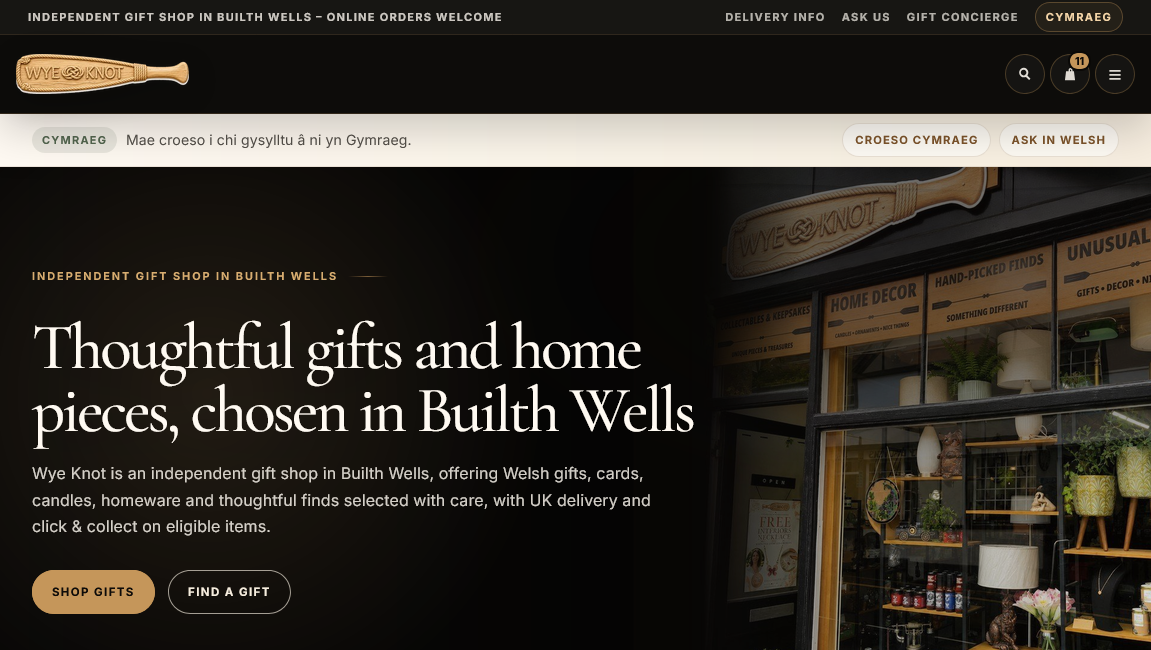
Wye Knot is not a demonstration project. It is the independent high-street shop I run in Builth Wells, where the website, catalogue and product workflow have to perform under the pressure of day-to-day retail.
Live storefrontCatalogue structureRetail operationsHuman review
The operating problem
One product.
Many jobs.
Adding a product was never just a matter of filling in one page. The same information had to be interpreted, rewritten, structured and checked repeatedly before it was useful to customers or connected channels.
“The problem was not one difficult task. It was repeating the same judgement across all of them.”
- 01SourceSupplier information, imagery and identifiers arrive in different formats.Collect
- 02CatalogueTitle, brand, category, attributes, SKU and product facts need a dependable structure.Structure
- 03Customer pageProduct copy has to be useful, natural and specific enough to help someone decide.Write
- 04SearchSEO fields, internal context and product language need to support discovery without distorting the copy.Optimise
- 05Connected outputsApproved information may then be prepared for feeds, marketplaces or other suitable channels.Reuse
- 06Final reviewFacts, claims, pricing and presentation still need a human decision before publication.Decide
The change in working method
The answer was not to work faster. It was to stop doing the same work six different ways.
Before
6 hours
At the upper end, a suitable product could absorb hours of work across writing, optimisation and preparation for connected channels.
Current workflow
<10 minutes
Approved source information is used to prepare a consistent, review-ready product record, with final approval remaining a human decision.
Measured in my own retail operation. “Under ten minutes” applies to suitable products where the source information is sufficiently complete and approved; it is not a claim that every product can be processed in that time.
The system I built
One product record moves forward. It does not keep starting again.
The workflow prepares the information in a controlled sequence. Each stage has a specific job, and the human review point sits before customer-facing publication rather than after it.
Normalise brand, category, attributes, identifiers and the core facts future outputs depend on.
Product recordDraft customer copy and appropriate outputs from the same structured record.
AI-assisted preparationCheck accuracy, claims, tone, pricing and suitability before anything goes live.
Human decisionSend approved information to the storefront and suitable connected outputs.
Controlled outputPRODUCT / SINGLE SOURCE
- Identity
- Title · SKU · GTIN · brand
- Structure
- Categories · attributes · product facts
- Customer
- Short description · story · useful detail
- Discovery
- SEO fields · relevant supporting context
- Outputs
- Storefront · suitable feeds and channels
Human control is part of the system
Automation stops at the decision.
Saving time is useful only if it does not weaken accuracy or judgement. Wye Knot therefore treats AI-assisted output as preparation — not permission to publish.
01Product factsAre the source details correct and sufficiently complete?
02ClaimsIs every customer-facing statement supportable?
03Commercial judgementAre pricing, positioning and the proposed channel appropriate?
04Final presentationDoes the product read naturally and fit the Wye Knot catalogue?
Customer-facing proof · desktop to mobile
The workflow only matters if the customer experience holds together too.
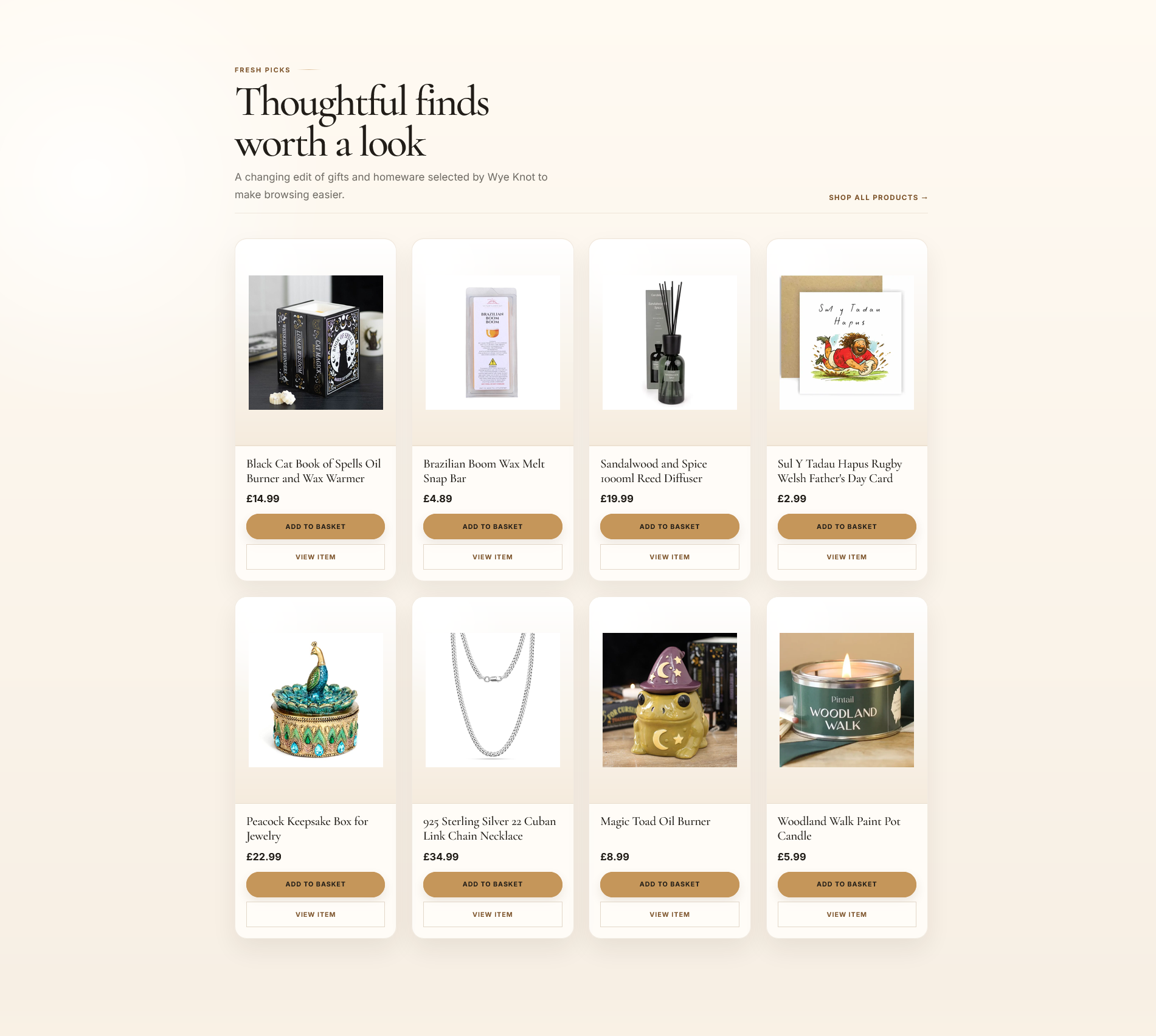
Current Wye Knot screens show the storefront, collections and product detail at larger widths, while the mobile content-order maps show how the same catalogue reflows on a phone. The hierarchy and product facts have to survive every change in viewport.
The technology behind the workflow should disappear here. Customers should simply see a considered shop that is easy to browse, understand and buy from.
DESKTOP / COLLECTIONS

DESKTOP / MERCHANDISING
Responsive field test
Same catalogue.
Different viewport.
Responsive design is not a desktop page squeezed smaller. Navigation, filters, product cards and supporting information have to change shape without losing the decisions a customer needs to make.
- Tablet
- Three-column browsing retains density without crowding.
- Mobile
- Products become a single, deliberate reading and buying sequence.
The layouts below show the same Wye Knot hierarchy at a deliberately readable scale.
WYE KNOT
SearchBasket
WYE KNOT COLLECTION
Candles
Collection context stays visible before products.
AllGiftsNew in

Black Cat Oil Burner
£14.99Add to basket
Brazilian Boom Wax Melt
£4.89Add to basket
Sandalwood & Spice Diffuser
£19.99Add to basketProduct detail · one record, two contexts
The useful detail cannot disappear when the screen gets smaller.
The same product record carries the image, price, product story, useful details, delivery context and buying action. On mobile, the order changes — the substance does not.
The proof below focuses on the hierarchy customers actually use to decide and buy.

CANDLES
Bee Radiant Wildflower Tube Candle
£8.99Price, reassurance and the buying decision stay together.
- Delivery shown before checkout
- Availability stays clear
Useful copy explains the product without hiding the facts.
Dimensions, delivery and FAQs stay easy to find.
Measured result
<10minutesto prepare a suitable product record for review, where approved source information is available.
What changed in practice
Less repetition. Better structure. The final decision still belongs to the retailer.
The gain is not simply faster copywriting. The same approved product facts can support the customer page and suitable connected outputs without being interpreted from scratch at every stage.
That makes the catalogue easier to maintain and leaves more of the working day for the parts of retail that still need judgement: buying, pricing, merchandising, customers and the exceptions no automated workflow can sensibly predict.
- 01Repeated product preparation reduced
- 02Structured information reused more consistently
- 03Human approval retained before publication
What this case study proves
“A retail system is useful when the technology disappears into the working day.”
Wye Knot gives Morris Standard something a portfolio mock-up cannot: a live business in which the consequences of a digital decision show up in real admin time, real catalogue quality and real customer journeys.
That first-hand operating context is why I look beyond the storefront when I work on ecommerce. The customer-facing website matters, but so does the workload needed to keep it accurate.
A practical next step
If your ecommerce workload has grown faster than the system behind it, start with the work that keeps repeating.
We can look at the storefront, catalogue, product data and the routine work around them, then decide what should be improved, connected or left alone.